Showing posts with label horses. Show all posts

Monday, September 16, 2013

The Virtual Trail Ride

I have come to the realization that I will never get all the stuff done that I should.

I'm the kind of person who makes a To Do list in the morning, turning the paper sideways and scribbling in the margins to cram in all the things that I delude myself into thinking I can / will / should / must accomplish before hitting the pillow that night. More often than not, my daily To Do list becomes my weekly To Do list, as more and more tasks find there way into the blank spaces. If I do something *not* on the list, I've been known to find a space to write it in, just for the satisfaction of crossing it out.

Helmet: check. Sunglasses: check. Perfect day: check!
I could write non-stop, 24-hours a day and I still wouldn't get everything written that I want to. Plus, my family would suffer. I could "Mom" and "Wife" constantly, but still not be World's Best Parent or Spouse. And no writing would get done. I could dedicate myself wholeheartedly to keeping a perfect house, but everything else -- writing, family, AND sanity -- would fall by the wayside.

This realization should stress me out. It probably would, but I have the perfect antidote to stress: a trail ride in Michigan fields on a crisp late summer morning.

Come with me, and you'll see...

I'm on Lily, a 16-year old, 16.3 hand black Percheron mare. My friend is riding Armani, an aged Hanoverian mare she rescued from severe neglect earlier this summer.

We head out behind the barn and take the field road to the back of our property:


Izzy, the German Shepherd, leads the way.

The day is perfect: Maxfield Parrish-blue sky, spectacular clouds, no bugs (!!), and no hunters (for a few more weeks at least). Everything smells earthy and warm.

 
A light breeze blows, and a red-tailed hawk calls while he circles overhead.

The dogs happily explore every new smell that presents itself. We keep an eye on them to make sure they don't decide to go on a trail of their own. Izzy & River the Wonder-Pit roam together...


Hitch, the kelpie, is the caboose to our train.


A left through the back of our field...

And we hit the dirt-bike paths. Trotting time!

River drops back and runs beside us, ears flying:

A mile and a half later, everyone is ready to take a break. Including Lily (aka "Miss Fluffy Pants"). So we wander into the woods.

Turn right just past our neighbor's trailer that he uses for harvesting wood. There's a path through the trees. Trust me...


Aaaaahhhhhh. It's so quiet in here, you can hear the horses' feet reverberate on the ground like a giant bass drum. It is the most relaxing sound in the world.


It rained last night, but only a few spots on the trail have any water. The horses don't mind mud and slog through without hesitation. Izzy, the water hound, sits her fuzzy butt in the puddle. Though it's a gorgeous day, Lord knows we need more rain.


We come out of the woods onto a long-abandoned blueberry field and orchard. Though it looks inviting, we don't trot. Not only has it been a long time since the trees were pruned (a real consideration when one rides a draft horse), but the ground is unpredictable, too.


You have to look sharp: portions of the path have been vandalized by moles and groundhogs. Whenever you spy a hole, steer wide and point it out to anyone else riding with you.

We find enough holes that have shown up since we last rode here that we decide this will be the final ride through the old orchard this year. There's no reason to invite trouble -- there are lots of alternative places to ride. 

We meander over to another neighbor's field. Izzy finds a woodland creature. She searches valiantly for it, but comes up empty:

Our neighbor, Bill, is an avid hunter. His Heavenly Hunting Shack -- complete with heater, working windows, and a bird's eye view of the entire field -- is just ahead and to the left. Horses in training often suspect it is out to get them. After awhile, they accept it. Lily ignores it.

The Heavenly Hunting Shack. Deer beware!

I'm too busy trying to take a picture of the HHS and I neglect steering. Lily gently veers toward home, but I veto that idea. One thing you can always count on: your horse will always know the way back to the barn.

We take another wooded road that we haven't ridden on lately, only to discover a huge tree has fallen across it. Fortunately, our horses are both surefooted and used to trail-blazing...

Meanwhile, the dogs play in the ditches that line the path...
Can you see the dog in this picture?

The wood road ends at a roadside field. The dogs are ecstatic. Evidently, the field is the canine equivalent of the Daily News.

We ride the perimeter of the field and realize that we've already gone about five miles. The dogs are finished catching up on the news in the field, and they're starting to make fewer and fewer forays off by themselves. It's time to be heading home.


So, it's back through the woods and over the downed tree...


When we skirt the orchard, the dogs stick close by. Miraculously, they never get stepped upon.
We trot and canter one final lap around the open field...
Then we head home...


The horses know where they're going: back to the barn for a good grooming, some cookies, and turnout.

You can almost hear us all go aaaahhhhhh. Stress? Gone.

Now, to tackle that To Do list...

Sunday, June 16, 2013

Discovering the Depths of Subtext

Lately I've been thinking a lot about subtext and one's ability to communicate with one's target audience.

Subtext -- conveying meaning and understanding without clearly stating the information -- is one of the publishing industry's favorite bits of jargon. Good writers excel in using subtext to engage the reader. When applied correctly, subtext adds depth, layers, and texture.

Many how-to articles try to tell writers how to incorporate subtext in their work. But thanks to a recent Twitter exchange, I've come to the conclusion that most of them miss what should be an obvious starting point. You see: in order to master subtext, the writer must first make sure that the stuff on the surface is interesting and engaging in its own right.

Why? Because the deeper stuff will be lost on some readers.  

Not all readers are created equal. Not every person who reads a work will possess the necessary tools to enable him or her to appreciate the extra nuances subtext provides. If a reader must understand the subtext in order to appreciate the content, the writer has done little more than craft a Members Only piece. Though it may stop shy of navel gazing, it is the literary equivalent of delivering a heartfelt sermon only to choir members.

The Twitter exchange / subtext kickoff I mentioned began with this picture, posted with the caption "Gabbing gals":
Photo by @subjectplusverb. Used by permission.
The ensuing exchange illustrated how one's understanding of the various layers of subtext affected one's understanding of the photo.

Layer I: The Surface

Some people looking at this picture bring with them a limited understanding of horses and training. Those not "in the know" don't see anything except the obvious. But that doesn't mean they can't find things to appreciate.

The endearingly citified Yi Shun Lai (@gooddirt) confessed: "All I see is the literal ponytail."

And this is fine.

The picture contains an element -- a pony tail in a ponytail -- that is both interesting and unexpected enough to engage even someone who is not a horseperson. Likewise, some people will never delve deeper in the written word. It is the wise writer who deliberately crafts scenes to maintain surface tension.


Layer II: The Composition

Even non-horse people can dive a bit deeper when looking at the photo in question. Some might find their eye following the sight line of the legs' shadows. Though both horse and human are so well aligned that their shadows merge seamlessly, the shadow originates with the girl.


Now, it is entirely possible that this element of composition, the merging shadows that enable the viewer to think in terms of metaphor, was a happy accident; a coincidental construct. Nevertheless, the mere act of taking the picture involved forethought and intent.

So, though some might read more into a text than the writer consciously intended, never underestimate the power of the subconscious muse, sprinkling poetic subtext like fairy dust to brighten the astute reader's day.


Layer III: The Intended Audience

I would wager that most "horse people," upon seeing the original photo, zero in on the horse / human connection. For those who speak horse, this is a lovely representation of communication, contentment, trust, and companionship.

The horse is dry, not sweaty. She hasn't been run into submission. Her ears are relaxed; she is at peace, yet she is willingly placing herself in close proximity to the handler.

No pressure on the halter or on the lead rope forces the horse to stay in place. She is where she is out of choice, not coercion.

The trainer's body language is one of calm, reserved acceptance. She, too, is relaxed. Her shoulders, arms and hands are quiet and contained. She is not forcing her presence on the horse or imposing her will on the mare.

The mare is not your typical riding horse. She's a heavy breed, probably weighing close to a ton. She's also clean, well-fed, well-groomed, and healthy. She's symmetrical and sound, which means that she enjoys excellent care, in addition to enjoying her handler's attention.

All of the above information is immediately available at a glance to people familiar with horses. It doesn't matter if they ride English or Western. It doesn't matter what language they speak, what breed they prefer, what country they live in, or how accomplished a rider or trainer they are. Such information contained in this single photo is the equivalent of genre-specific subtext -- readily grasped by fans, but lost, perhaps, on those unfamiliar with a particular literary category.


Layer IV: Privileged Information

Then there is the information that unpacks the photo still more, if one knows where to look for it.

For instance, only those familiar with the Natural Horsemanship training philosophy will recognize the equipment and be able to identify the handler's training influences.

The black rope halter could come from several sources: Clinton Anderson, Double Dan, Josh or John Lyons, Buck Brannaman, to name only a few. But the Dans, Lyons, and Brannaman don't generally use hardware on their leadropes, so that narrows things down...

It's the stick that speaks volumes. Lots of trainers use sticks: Clinton, Steve and Wendy Smith, Pat Parelli, and more. But the color is a giveaway. The "carrot stick" is orange: practically shouting "Parelli!"

Which means there's a good chance that the trainer is a PNH fan. If so, she probably knows the Seven Games, understands her mare's "Horsenality," and is working on improving her grasp of the Four Savvys.

Which also means that though there is more to unpack in the photo for those who are Natural Horsemanship aficionados, some of the subtext therein is lost -- even on horse people. It is possible for subtext to apply only to the Chosen Ones. Those not in the know find it as difficult to decipher as the preceding paragraph.

In writing, it's common to salt in such privileged information for hardcore fans. That kind of subtext is the equivalent of gaming Easter eggs -- of interest and of use only to a select few. 


Layer V & Beyond: The Murky Depths

And then there's the Super Deep Seafloor Subtext. This stuff may resonate only with one or two people on the planet. In fact, it may hold meaning only to the writer.

For instance, I don't know enough about the mare and the trainer in the picture to know their history.

But what if the mare was a rescue? Or if she had a serious attitude problem that had perplexed other trainers? What if she had colicked recently or had recovered from a serious leg injury? That knowledge would make the picture one of supreme achievement: overcoming the odds to reclaim what others considered lost.

Or... Imagine if financial or medical concerns beyond the girl's control had necessitated selling the mare to a new home. This photo could be documenting the last time they ever worked together: a penultimate goodbye, adding tragic undertones to the image.

Or... What if a lifelong fear of horses had plagued the girl? That tidbit of information could tint the picture with several shades of empowerment and optimism.

If such backstory is available only to a few souls, then the subtext associated with it is lost to the larger audience. However, that doesn't negate its influence on those privy to the information.

The wonderful thing about subtext is that it provides a well of meaning for the words we write. If done correctly, it offers something for everyone. It entertains those content to just scratch the surface, yet rewards those willing to dive deeper.

Super special thanks to @SubjectPlusVerb and @ReadSchmead for the use of their picture for this post! -- A.H.

Monday, February 18, 2013

Hobby Horses: Q & A with Model Horse Artist Stacey Kianese

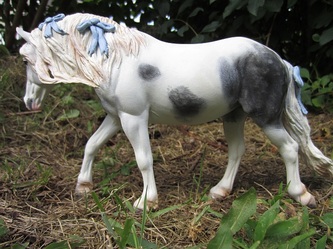
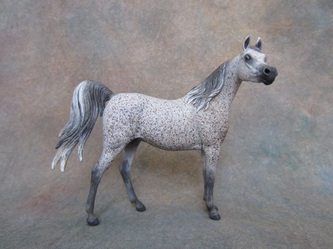
I’m thrilled to introduce my readers to my uber-talented cousin Stacey Kianese. Stacey customizes model horses, taking them from static, cookie-cutter resin figurines to miniature works of art. Her models have NAN-qualified and earned numerous championship ribbons. (View Stacey's gallery.)

Stacey blogs about custom model horse painting and showing at Trillium Studio.

Her blog posts frequently wax eloquent about the vagaries of her hobby and the subjective nature of showing one’s art in competition. They contain so many parallels to the Wonderful World of Writing that they made me realize how closely all creative endeavors are related – up to, and including, the occasional self-doubt that seems to plague every artistic soul. Though the medium may differ, the journey is the same.  Stacey’s passion for her art inspires me. I trust it will you as well…

 Q: How did you get started modifying, sculpting, and painting model horses?

A: I collected Breyer horses way back when I was a kid and I always loved them. Those horses are long gone. Back in 2008, I was on Ebay and I somehow came across a customized Breyer and was blown away with how cool it was. I was shocked to see how much money it was going for. I did a Google search, which lead me to various web sites, blogs, etc. and as they say, the rest is history. 


Q: The model horse world has its own language and acronyms just as the publishing industry does. Can you provide a quick lexicon of common terms for those unfamiliar with the hobby?

A: Here's a quick summary. 
  • RR - regular run.  This is a horse right out of the box, direct from the manufacturer. 
  • OOAK - one of a kind.
  • LR/SR - limited/special run.
  • CM - custom.  A custom can be as simple as a straight repaint or as complex as completely hacking the model apart and resculpting it. 
  • AR - artist resin. These are limited runs purchased directly from a sculptor. They are not cheap, LOL. They are very addictive and are usually way more detailed than your store-bought Breyer. Some highly sought after resins can go for over $1,000.  They are also sold unpainted, so in addition to buying the resin, you would have to commission an artist to paint it. This is also expensive and why I developed my skills so I didn't have to worry about commissioning somebody.

Show holders can submit an application to NAMHSA (North American Model Horse Shows Association) to have their show NAN approved. This means 1st and 2nd place horses will get a NAN card and are eligible to show at NAN (North American Nationals).  You can get a card in Breed, Collectability, Workmanship, and Performance.  


Q:  What are some of the things you have learned from your hobby?

A: I have learned so much about horses by showing. You have to know what colors are acceptable in certain breeds.  For example: no Appaloosa-like spots or blankets on Saddlebreds; no roan Morgans; and no buckskin Arabians. 

I’ve also learned that you don’t have to be rich to be competitive. A lot of people spend big bucks on their models, but you don't have to. I bought a little Arabian stablemate for a buck at a horseshow because I felt sorry for it. I took him to a show and threw him on the table as a joke and he got 4th in a class of 20+ horses last year.

And, of course, I’ve learned that there is no such thing as a “sure thing.” Sometimes I find that the horses I think will kick butt don't place and the ones I bring just to put something on the table get the blues!


Q: What do you like best about working with models?

A: For me, my biggest thrill is taking a blank resin and transforming it to a lifelike horse.  Taking care to paint the markings in the correct growth pattern, detailing the eyes and hooves, achieving a realistic coat color -- it's GREAT! 

I work in pastel pigments but some people work in oils or acrylics.  Pigments are pretty messy and take a lot of patience but I feel that medium gives the most realistic depth of color.

There are many steps involved in getting the horse ready for paint.  You have to sand/scrape off seams, you have to bathe the model in Ajax to get rid of any release that may be on the resin, and you have to put a coat or two of primer on it so your medium will stick. Crappy prep job = crappy model, so prepwork is important.  That is why I am so geeked whenever I get ribbons in workmanship classes.


Q: The process of submitting your work for judging is a bit like that of a writer submitting a manuscript for publication. How do you maintain a positive attitude in a highly competitive hobby?

A: I’ve been known to have a crisis of artistic confidence. It's nice to hear somebody other than your spouse / family likes your stuff. We all know that!  Nothing sucks more than to have a model up on the table that you've put your heart and soul into, and the judge doesn't even look at it. Aarrgh!

The thing I keep telling myself is: it is all a matter of opinion. Some judges just don't like sculpts by certain artists. Some judges don't like certain colors. Some judges don't like certain breeds. It just depends on what is on the table and who is judging. 

Then there is the cliquey thing. Nobody likes to admit it but if the judge knows you and likes your stuff, they'll pin you. Also, if it is a popular mold, done by a "big name artist," it has a pretty good chance of getting pinned. 
I think my biggest problem is I have high expectations. Perhaps too high.  I was talking with another hobbyist about "only" placing third. Woe is me!  Waaa!  She put it into perspective for me, telling me the class was large and there were some pretty big name painters on the table. She then went on to say she would have been thrilled with a third. That was my "A-Ha!" moment when I realized maybe I was being just tad harsh on myself.

I don't do commissions. Period. Too much pressure. What I do like to do, however, is donate items to shows, swap customs with fellow hobbyists, and sell stuff on Ebay once in a while. Though ribbons and sales are nice, they’re just the icing on the cake. The real fun is in bringing your vision to life, making something that has never been made before. I have a lot of ideas a-brewing and I can’t wait to get cracking!


Saturday, December 17, 2011

The Fourth Day of Christmas: Gratitude for Calm Horses

"On the fourth day of Christmas,
My true love gave to me:
4 calm equines,
3 fuzzy dogs,
2 flightless birds,
and an old farm in the country."
As my revamping of the 12 Days of Christmas continues, I can't pass up an opportunity to voice my gratitude for my four horses.

Theo: My Big Buddy.
Specifically: I am exceedingly grateful for their well-trained calm.

Too often, upon discovering that I have horses, that I train them, or that I've written horse-themed books, someone will say, "Oh. I had horses once." (Occasionally, this sentence is modified to "I rode a horse once.") What follows inevitably is a tale of destruction, woe, and a near-death experience.

"It didn't want to leave the barn, see, 'cause that's where its friends were. We tried to take it out on the trail, but it took off for home. It ran about 56 miles an hour through an orchard. I held on for as long as I could, but..."

OR

"He'd been a racehorse, see, so it didn't have any steering or brakes. Once I was riding it. My two little sisters and me were bareback on it. And the neighbor's dog came out and spooked it. It took off hell-bent for Sunday. We hung on as long as we could, but..."

The people who tell such tales come in all shapes, sizes and colors, but their stories are astoundingly similar. I always feel sorry for their lack of quality horse experience.

For me, the best part of having a horse is the relationship we have. I love walking out to the pasture and having a creature that weighs over a ton see me, leave his grass smorgasbord without a backward glance and come thundering up so I can scritch him.

Today, we have four fabulously Zen equines:

There are the two Percherons, Theo and Lily.

Hannah, the Quarter Horse / Paint, is my daughter's mare -- an honest babysitter if ever there was one.

And then there's butterball Birdie, a Welsh-something pony who rides and drives, and whose favorite place to be is in your pocket, looking for treats.

They're not deadheads -- far from it. All of them can get up and go far faster than I can move. But the wonderful thing is that when they choose to move, they do so as willing partners instead of trying to get away from me.

My horses are an integral part of my life. Their beauty, grace, strength, and trust provides me with a source of constant wonder. Every time I look out the window, my heart overflows with gratitude.

Monday, September 19, 2011

Drive Thru Writing #Goals

For the past several years, my friend & neighbor Sheila has had a goal: To drive through the McDonald's drive-thru. With her horse.

Sheila works full-time. She's got kids. Grandkids. In the past year, her mother-in-law who requires hospice care and close attention has moved in to their small farmhouse. She's had horses for years, but she's not what one would call "accomplished." Oh, sure she can ride. She can drive. But she's never shown. She's not one of those horse people.

The fact that she has zero desire to ride or drive competitively has not stopped her from having a goal. When she got Will, her grade Belgian gelding, she announced "I want to take him through the McDonald's drive-through."

Which is 5 miles away, on the other side of town.

There were a thousand and one reasons why she shouldn't reach her goal. It's a long way away, as the horse walks. It's infinitely easier, faster, safer, and saner to jump in the car and turn the key anytime she's craving fries. But where's the fun in that?

Some people laughed with tell-tale condescension when they heard Sheila's goal. They didn't say "That's silly" to her face. They didn't have to. She could tell who supported her and who thought she was nuts.

We writers know a bit of having drive-thru goals. Often, just saying "I want to be a writer" qualifies. Writers quickly discover a thousand and one agents, publishers, and editors who don't share their vision. When we begin a novel, writing "the end" is a long way away, as the plotter plots. It's easier to read someone else's book than to write our own. Ah, but where's the fun in that?

I facilitate a weekly Writing Practicum for writers pursuing publication. Traditionally, when a new writer joins our group, I ask for a backward introduction. "Introduce yourself to us as if it is three years from now."

Wonderful intros from accomplished, New York Times bestselling novelists and wildly successful authors tend to ensue.

"Now introduce yourself again. This time, as it if is one year from now."

We are treated to visions of brilliant writers poised on the brink of publishing success.

"Now, please tell us who you are today."

And we meet the aspiring writer with drive-thru goals.

Nothing -- NOTHING -- is wrong with drive-thru goals. We all have them. So what if no one else shares them? So what if people think our quest is laughable or futile? Who needs the naysayers?

Don't listen to those who tell you life would be easier, faster, safer, and saner if you only had different priorities. Keep your eyes on the prize. Practice your craft. Know the route you want to take. And one day, if you stay true to yourself and to your writing, you'll make heads turn when you make those dreams come true.

All photos courtesy of my dear friend Sheila LeBeau. Taken Sept. 5, 2011.