This is a true story. I swear. I know the people it happened to.
It has nothing to do with writing, but everything to do with how truth trumps fiction every time.
Plus, it makes me laugh.
::ahem::
A few years ago, my BFF's husband was stationed in Iraq with a guy whose wife, back home in Michigan, became good friends with my BFF.
When the other
woman's husband was scheduled to come home on leave, she wanted to do something "special" for her man. So she decided to go to -- you know -- an "adult" store and get something to
make his homecoming... memorable. She, however, wasn't the sort who frequents stores like that and
didn't want to go by herself. (Incidentally, neither BFF nor I are Adult Store denizens
either. In case you were wondering...)
Anyway --
BFF said she'd accompany the woman on her shopping trip, lending support, though perhaps not of the moral variety.
Once in the doors, the woman had great fun buying... stuff.
Condoms and flavored oils and edible underwear and...
stuff.
She brought all her new purchases home and put them in a brown paper bag in her
bedroom to keep them away from the prying eyes of her kid.
I ate what?!
...
Where her dog discovered it and thought the canine equivalent of: YAY! COOL NEW FLAVORS AND SMELLS I'VE NEVER
SMELLED!
And promptly ate *everything.*
Upon discovery of the doggy snacker, the woman called BFF freaking out, wondering if Mr. Dogness could be in any danger from what he ate because
there was No. Way. In. Hell she was going to call the vet and tell him what
the dog had ingested.
This weekend, one of my best friends and I attended a Bon Jovi concert, which was (of course) extravagantly fantastic.
On what do I base this pronouncement, you may ask? Consider:
It's one thing to be a hot 20-something band playing to a crowd of hot 20-something fans, getting them fired up, calling out, and caught up in the music. I mean, honestly -- when I was 20, I'd endanger my car speakers if a song played on the radio that I *sort of* liked.
It's another thing entirely to be a hot 50-year old (if only all men aged half so well...) headlining a band of your contemporaries (good LORD, Tico Torres turns 60 this year! Drumming does a body good!) playing to a crowd, many, if not most, of whom remember when MTV banned the music video for "Living in Sin" because it was too racy.
The original high school and college-aged fans have grown up. They now have kids of their own. Grandkids. Mortgages. Medical issues. Responsibilities. Bed times. It can take a Herculean effort to get them off the couch and out of the house. Imagine trying to get them out of their seats and on their feet for almost three hours!
Yet that's exactly what Jon and the band did. From eight o'clock till eleven, they had me and 20,000 of my closest friends standing, rocking along with them while they performed songs from the past 30 years right up through the present, from "Runaway" to "Amen." It was a testament to how the band, like a fine wine, has only improved with time.
It was also a study in How Times Have Changed and a rather sad testimony to how we have allowed technology to rob us of yet another Great Experience.
I, in center floor seats, saw this:
But, in a living example of what the University of Iowa's professor Brooks Landon
terms "our increasingly mediated society," the vast majority of the concertgoers
experienced the entire live event vicariously through the lens of a 4"
screen. Most of the people around me saw something more like this:
We're trading experience for pixels, distancing ourselves from what we're trying to embrace. Perhaps even more distressing, in doing so, our attempt to capture something cripples our ability to live in the moment and fully experience it.
We aren't the only ones to pay the price when we choose to fill memory cards rather than our actual memories. A friend with different musical tastes than I recently attended a Clint Black concert with her husband. Several times during the course of the event, Clint stopped the concert and kindly asked the audience members to put their cell phones on "airplane" mode, because the electronic feedback was killing his ears.
So it has come to this. We literally script our lives, preferring to upload them in bite-sized set pieces online in order to pander to the random viewer and furiously thumb-texting people who are not present, rather than commit to the moment and engage with those who share it.
Experiencing a live event through the screen of a phone is as satisfying as licking an ice-cream cone with a sock on your tongue.
Two hours and forty-five minutes into last night's concert, in the early notes of the final song, the phone battery of the woman standing next to me died. She was terribly upset, briefly grumbling to her friend (who continued recording), before putting her phone away and resigning herself to finishing out the night phone-free. Soon, however, she was singing and dancing along with the rest of us who were unencumbered by recording devices -- the first time all evening she connected with the band instead of with the gadget in her hand.
In 1989, Jon Bon Jovi and Richie Sambora distanced themselves from amplified, production-heavy sound and played an all-acoustic set for the MTV Video Music Awards. Six months later, MTV unveiled their award-winning "MTV Unplugged" show, which has remained popular ever since.
Why not do the same?
Unplug yourself. Turn your phone off. For a few blissful hours, take a technology sabbatical. Dare to not record a thing. Revel in your freedom from Facebook, Twitter, and texting. Cut the power cord. Remind yourself that this moment -- THIS moment -- will never come again. Take a break from mediating, editing, and uploading. Stop scripting your life and just *live* it. Then, get ready to rock!
On several recent occasions, I've had the opportunity to get involved with people who, for one reason or another, didn't think very highly of their writing abilities.
Some were motivated to improve their writing. Others were more fatalistic about the merits of their words.
I believe that everyone has something to say. I enjoy working with writers of all skill levels, helping them to see beyond their (often self-imposed) limitations.
I wish every writer who bemoaned his or her ability could meet one of my chickens...
One day, with great fanfare and fluttering of wings, a hen flew up to the top of the laying house. A little while later, she set her sights higher and made it to the top of the chicken house.
She looked down on the lesser poultry beneath her, and contemplated re-joining them for some time. Then, she looked up.
The tree branch above her head must have looked inviting. It took some doing (and no small amount of cackling theatrics), but she finally made it.
Then, she headed even higher.
The first day she made her foray above the ground, she strutted back and forth for over an hour before flying back to the chicken run.
Now, chickens aren't known for their flying abilities. In the same vein, some people believe that getting their thoughts down on paper is an impossible dream. I disagree. I believe that if you can speak -- or even think coherently -- about a thing, you can write about it. Sometimes the best prescription for doing a thing is not knowing that it's beyond you.
Some might point out that my chicken never progressed from where she started. But that argument misses the point entirely. She chose to return. She came down from the tree in her own time, on her own terms. But she now knows that, if she wants to, she can fly.
Yi Shun Lai (http://www.thegooddirt.org) has been a writer and editor for over 15 years. She's written or edited for The Los Angeles Times, the Christian Science Monitor, the J. Peterman catalog, and Audubon magazine, among others. She makes her living writing corporate copy and executing content strategy.
Yi Shun writes literary essays and short fiction and is the fiction editor for the Los Angeles Review.
I am grateful Yi Shun graciously agreed to return and answer a few questions demystifying the fiction editor's role.
Q: What is the most common misconception about your role as a fiction editor?
A:That I live to reject people. Seriously. I like to read and acquire and publish fiction. That's why I'm here.
Q:What do you consider the best part of an editor's job?
A: Discovering new styles, new ways of expression, new and innovative ways of telling a story. (I don't necessarily mean that experimental fiction is my shtick. I mean that words have infinite possibilities.)
Q: What's the toughest part of an editor's job?
A: Working with an author to revise a piece. Sometimes you get work that you want to accept, but that isn't quite right as-is. There's a huge amount of humility, and a little bit of embarrassment, involved in asking a writer to revise his or her work to fit your aesthetic. Fortunately, every writer I've worked with has been gracious and grateful for suggested changes. If we're suggesting changes, the intent is to make the work better.
Q: What specific advice do you have for authors to improve their chances for getting their submissions accepted?
A: Please, please, read the fricken publication before you submit. When I was at the Atlantic as a fiction intern I got stories about foot fetishes. Three of them over my eight-week tenure. Okay, really???
And get someone else to look at the thing before you submit. Critique groups are incredible things. So are second readers. Use them.
Q: If you could permanently eradicate one submission error you see all the time that most pushes your This Irks Me button, what would it be?
A: Papyrus font. Seriously, folks: Times Roman or Courier. Don't be fancy-pants, m'kay? I can't read fancy-pants. Also, we usually have a few submissions that exceed our 4,000-word limit. Don't do this. It's in the guidelines for a reason.
Q: In general, how far do you have to read in a submission before you realize you love it and want to acquire it?
A: All the way through. I once got to the penultimate paragraph of something, only to have it fall apart in the last paragraph. Horrors! The same is not true for deciding something's just not for us.
Q: Why do you feel a writer should publish his or her work in periodicals like the Los Angeles Review?
A: Platform. Everyone says it, no one knows what it means. It means that when I google you, you pop up someplace. It means you have legitimacy, street cred, a background. It means you care enough to support the arts and contribute to them.
You publish in literary magazines because you think your work deserves to be seen. And when you publish, that means someone else thought your work deserved to be seen, too. That's pretty powerful stuff.
More practically, the stuff in literary magazines is good work that sometimes never gets seen anywhere else. That's why we're here.
Q: You write as well as edit. What has being an editor taught you about your writing?
A:Mostly, that you learn from everything you read. That is, I learn from other writers. That could be something as broad as pushing the boundaries in story-telling, or it could mean something as specific as word choice.
Q: What are some things you would like to see more of in your submissions in-box?
A:My submissions in-box is pretty great as it is. We have a really lovely mix of male and female submitters, and we have some great minority literature and viewpoints. But I'm always looking for LGBT and minority stories, and work that isn't young adult but that revisits that time in our lives. I'm a softie for the teen years, for some reason.
Q: If people wish to submit fiction to the LAR, what is the best way to go about it?
A: Once you've familiarized yourself with our publication, go to our submissions page and follow the directions. I'm always looking forward to reading something amazing.
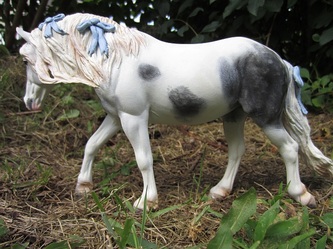
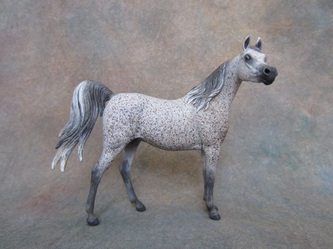
I’m thrilled to
introduce my readers to my uber-talented cousin Stacey Kianese. Stacey
customizes model horses, taking them from static, cookie-cutter resin figurines
to miniature works of art. Her models have NAN-qualified and earned numerous
championship ribbons. (View Stacey's gallery.)
Stacey blogs about
custom model horse painting and showing at Trillium Studio.
Her blog posts
frequently wax eloquent about the vagaries of her hobby and the subjective
nature of showing one’s art in competition. They contain so many parallels to
the Wonderful World of Writing that they made me realize how closely all
creative endeavors are related – up to, and including, the occasional
self-doubt that seems to plague every artistic soul. Though the medium may
differ, the journey is the same.Stacey’s passion for her art inspires me. I trust it will you as well…
Q: How did you
get started modifying, sculpting, and painting model horses?
A: I collected
Breyer horses way back when I was a kid and I always loved them. Those horses
are long gone. Back in 2008, I was on Ebay and I somehow came across a
customized Breyer and was blown away with how cool it was. I was shocked to see
how much money it was going for. I did a Google search, which lead me to
various web sites, blogs, etc. and as they say, the rest is history.
Q: The model
horse world has its own language and acronyms just as the publishing industry
does. Can you provide a quick lexicon of common terms for those unfamiliar with
the hobby?
A: Here's a quick
summary.
RR - regular run. This is a horse right
out of the box, direct from the manufacturer.
OOAK - one of a kind.
LR/SR - limited/special run.
CM - custom. A custom can be as simple as
a straight repaint or as complex as completely hacking the model apart and
resculpting it.
AR - artist resin. These are limited runs
purchased directly from a sculptor. They are not cheap, LOL. They are very
addictive and are usually way more detailed than your store-bought Breyer. Some
highly sought after resins can go for over $1,000. They are also sold
unpainted, so in addition to buying the resin, you would have to commission an
artist to paint it. This is also expensive and why I developed my skills so I
didn't have to worry about commissioning somebody.
Show holders can submit an application to NAMHSA (North
American Model Horse Shows Association) to have their show NAN approved. This
means 1st and 2nd place horses will get a NAN card and are eligible to show at
NAN (North American Nationals). You can get a card in Breed,
Collectability, Workmanship, and Performance.
Q:What are some of the things you have learned
from your hobby?
A: I have learned
so much about horses by showing. You have to know what colors are acceptable in
certain breeds. For example: no Appaloosa-like spots or blankets on
Saddlebreds; no roan Morgans; and no buckskin Arabians.
I’ve also learned that you don’t have to be rich to be
competitive. A lot of people spend big bucks on their models, but you don't
have to. I bought a little Arabian stablemate for a buck at a horseshow
because I felt sorry for it. I took him to a show and threw him on the
table as a joke and he got 4th in a class of 20+ horses last year.
And, of course, I’ve learned that there is no such thing as
a “sure thing.” Sometimes I find that the horses I think will kick butt don't
place and the ones I bring just to put something on the table get the blues!
Q: What do you
like best about working with models?
A: For me, my
biggest thrill is taking a blank resin and transforming it to a lifelike
horse. Taking care to paint the markings in the correct growth pattern,
detailing the eyes and hooves, achieving a realistic coat color -- it's
GREAT!
I work in pastel pigments but some people work in oils or
acrylics. Pigments are pretty messy and take a lot of patience but I feel
that medium gives the most realistic depth of color.
There are many steps involved in getting the horse ready for
paint. You have to sand/scrape off seams, you have to bathe the model in
Ajax to get rid of any release that may be on the resin, and you have to put a
coat or two of primer on it so your medium will stick. Crappy prep job = crappy
model, so prepwork is important. That is why I am so geeked whenever I
get ribbons in workmanship classes.
Q: The process of
submitting your work for judging is a bit like that of a writer submitting a
manuscript for publication. How do you maintain a positive attitude in a highly
competitive hobby?
A: I’ve been
known to have a crisis of artistic confidence. It's nice to hear somebody other
than your spouse / family likes your stuff. We all know that! Nothing
sucks more than to have a model up on the table that you've put your heart and
soul into, and the judge doesn't even look at it. Aarrgh!
The thing I keep telling myself is: it is all a matter of
opinion. Some judges just don't like sculpts by certain artists. Some
judges don't like certain colors. Some judges don't like certain breeds. It
just depends on what is on the table and who is judging.
Then there is the cliquey thing. Nobody likes to admit
it but if the judge knows you and likes your stuff, they'll pin you. Also,
if it is a popular mold, done by a "big name artist," it has a pretty
good chance of getting pinned.
I think my biggest problem is I have high expectations.
Perhaps too high. I was talking with another hobbyist about
"only" placing third. Woe is me! Waaa! She put
it into perspective for me, telling me the class was large and there were some
pretty big name painters on the table. She then went on to
say she would have been thrilled with a third. That was my
"A-Ha!" moment when I realized maybe I was being just tad harsh on
myself.
I don't do commissions. Period. Too much pressure. What I do
like to do, however, is donate items to shows, swap customs with fellow
hobbyists, and sell stuff on Ebay once in a while. Though ribbons and sales are
nice, they’re just the icing on the cake. The real fun is in bringing your
vision to life, making something that has never been made before. I have a lot
of ideas a-brewing and I can’t wait to get cracking!
I have a
writer friend who, while waiting for her big break (aren’t we all?),
writes for various local publications in order to pay a bill or two.
(Interesting
side note: writer's agents are also known to work a second or -- dare I
say it? -- third job in order to make ends meet before one of their
clients makes it big enough that the agent can eat something other than
Ramen noodles. True story.)
But I digress. Back to my friend:
She
was on assignment at a local winery’s wine tasting, doing research for a
small regional publication. The owner of the winery greeted her with,
“Isn’t (insert name of talentless local writer here) doing the write-up
this year?” Then the tasting began.
Toward the end of
the interview, the winery owner began waxing eloquent on the wine
tasting / chocolate party extravaganza he was planning in conjunction
with the owner of our area’s world-class chocolatier. This special event
was in the works in order to impress a writer for the Chicago Tribune.
Local press need not apply.
This, more than anything else, left a very bad taste in my friend’s mouth.
“What am I, chopped liver?” she wondered. Clearly, in the mind of the vintner, she was.
As
my friend related her experience, I thought of food critic Ruth Reichl.
When she was with The New York Times, her reviews held so much import
that her photo was posted in restaurant kitchens. Chefs offered rewards
for information on when she might appear at their establishment.
Since
her treatment was so preferential (not to mention reverential), Ms.
Reichl took to wearing disguises in order to more accurately sample what
a restaurant really had to offer. Often, the difference between the
food the critic was served, and the food the “real person” received was
so significant, that Reichl would write up two different reviews for the
same place! (For some sumptuous reading, check out Reichl’s book Garlic and Sapphires: The Secret Life of a Critic in Disguise.)
Back
to my friend. First, let me say that she knows her wine. She grew up in
California, has traveled extensively and has an educated palate. She’s
also a darn good writer, with credits in national periodicals and a
Masters degree in English to boot. Her current assignment may be for a
dinky little paper, but that doesn’t mean no one will read it. The
vintner would have done well to remember this.
As writers, too often we feel like the “little guy.” We feel overlooked, undervalued and – almost always – underpaid.
The
film industry routinely pays the screenwriter pennies to the star’s
dollar, without taking into consideration that great stories, great
characters and great lines are hard to come by.
I might be small, but I've got big-fish dreams!
The publishing industry is built on the agent's premise that "if I like it, but don't adore
it, then I won't represent you." It's easy for unrepped writers to
degenerate into the most pathetic, whiny, weaselly creatures, crossing
our fingers and praying to Whoever is Out There that one person will adore
what we've written. As if one person somehow has the magical ability to
transform us from a minnow into an enormous grand poobah of a big fish.
I
have ghostwritten bestselling books for clients who literally could not
be bothered to say “Hi” when I showed up at one of their public
appearances. At times when people begin to believe their own press,
perhaps someone should remind them who the press is.
If
you are stuck in “little guy” mode right now, afraid that no one will
ever recognize you for the brilliant, talented scribe you are, take
heart. Then take action.
Quit waiting for someone else to make your dreams reality. Search out other people who
are as overlooked as you.
Make friends with associate editors, junior
agents, interns and assistants. Form alliances, exchange favors, follow
on Twitter, become Facebook fans, attend conferences together... Join
forces and help each other gain recognition. You will be amazed at how
quickly “little guys” can grow.
A word to the wise, however:
Make a pact now to never forget where you came from and -- when you've finally made it -- to remember those who helped you get where you are.
We simultaneously loathe and love what we create. Regardless of our mastery of our craft, we know we will never achieve written perfection. Simply knowing of the existence of a more evocative line, a more graceful segue, a more compelling motivation, a stronger phrase keeps us humble. However, something about creating entire worlds from mere words feeds our creative soul, filling us with a parental pride no non-writer will ever experience.
Only delusional nitwits start writing because they expect to it to make them rich.
Oh, sure, one might harbor the secret desire to write something so amazing, so brilliant that the world beats a path to one's door, flinging fistfuls of money along the way. Love of money, however, makes a poor muse.
"Will this castle do, Mistress?" "GOOD DOG!"
A writer starts writing because he or she MUST. Any other reason ("I'm going to be rich!" "I'm going to be famous!" "I'm going to get a movie deal, and move to Hollywood, where I shall meet Matt Bomer and discover that he is secretly straight, and he shall fall desperately in love with me, and I shall live on the beach in a converted castle with an army of perfectly trained Welsh Corgi minions that do my bidding...") is destined for disappointment.
We writers tend to be a supportive bunch. I have never known a Real
Writer to deliberately squash another writer's dreams. (I'm sure it
happens -- being a writer doesn't make one a saint any more than having a
child makes one responsible -- but I believe such aberrations are
rare.) To the contrary, on numerous occasions, I have known writers to
generously use their time, expertise, education, and connections to help
a fellow writer on the road to publication.
Sadly, too often writers forget the flights of whimsy, inspiration, and creativity that caused them to start writing. They allow the callous remarks of non-writer naysayers (@DowagerAgent anyone?) to affect their optimism, their faith, and their productivity. They lose sight of the fact that one does not write to please the world; one writes to complete one's self.
If you want to marinate in a depressing sea, Google "Why I Quit Writing" or "Why I Stopped Writing" sometime, and follow the tendrils of misery that emanate from that Wood Between the Worlds. Just make sure you hide the razor blades and the Drambuie first. (Strangely, no one seems to notice the irony of writing about why you are no longer writing...)
Lately, I've had several conversations with talented writers who say things like:
"What if the book I've written isn't as good as I think it is?" "What if I've used up all of my creativity and never get another good idea?"
"What if I've wasted a year and a half of my life?"
"What if it doesn't sell?"
"What if I don't really have what it takes?"
They're all allowing themselves to flirt with the idea of quitting. As if becoming a writer was a conscious, logical decision they made that they can walk away from at any time.
It's not.
Being a writer is more of a calling than a career.
If you're a writer, you know the thrill of creating characters more interesting, more rounded, and more real to you than most people you know.
If you're a writer, you know that a part of you remains behind in your story when you must leave it in order to live your "real life."
If you're a writer, you know that if one is to consider it a waste of time to write, one might as well consider it a waste of air to breathe.
Granted, you might take a break from writing for a while -- especially if you've allowed yourself to fall into the trap of equating success with financial gain or fame.
But, if you're a writer, the Muse will not stand to be ignored for long. The day will come when she will smack you upside the head with an Idea so exciting that it will cause your heart to beat more strongly as the creative juices surge through you again. And you will realize that where there is breath, there is life. Pick up your pen! Run to your keyboard! Quitting is not an option...


 On several recent occasions, I've had the opportunity to get involved with people who, for one reason or another, didn't think very highly of their writing abilities.
 The first day she made her foray above the ground, she strutted back and forth for over an hour before flying back to the chicken run.